Mobile-App
How to setup a Quick Commerce App Like Blinkit, Zepto and Instamart
Breakdown of what it actually takes to build a 10-30 minute delivery app — and how QuickKart’s ready-made customer app, rider app and admin panel get founders there wit

Written from production. Our articles draw on products we run live and the client work behind them, and are revised as the systems they describe evolve.
Quick commerce has become one of the fastest-growing categories in Indian e-commerce. Platforms like Blinkit, Zepto and Instamart have trained an entire generation of urban shoppers to expect groceries, snacks and household essentials delivered in 10 to 30 minutes — not next-day, not same-day, now.
What began as a metro-city novelty has scaled into a multi-billion-dollar category, and it is still expanding into tier-2 cities, new categories like pharmacy and electronics, and adjacent formats built around the same instant-delivery promise.
For entrepreneurs and regional retail chains watching that growth, the real question is not whether quick commerce works — it clearly does — but whether to build a dedicated app of their own or stay dependent on aggregators and marketplace listings.
This guide is written for founders who want to actually own the platform: understand what a 10-30 minute delivery app genuinely requires under the hood.
It also covers the feature set a launch-ready build needs on day one, and shows how a ready-made platform like QuickKart takes a founder from decision to live app in weeks instead of a year of engineering.
Rather than stopping at ‘here’s what Blinkit does,’ this is meant to be a practical build reference — the kind you would hand to a technical co-founder or CTO before scoping a quick commerce project of your own.
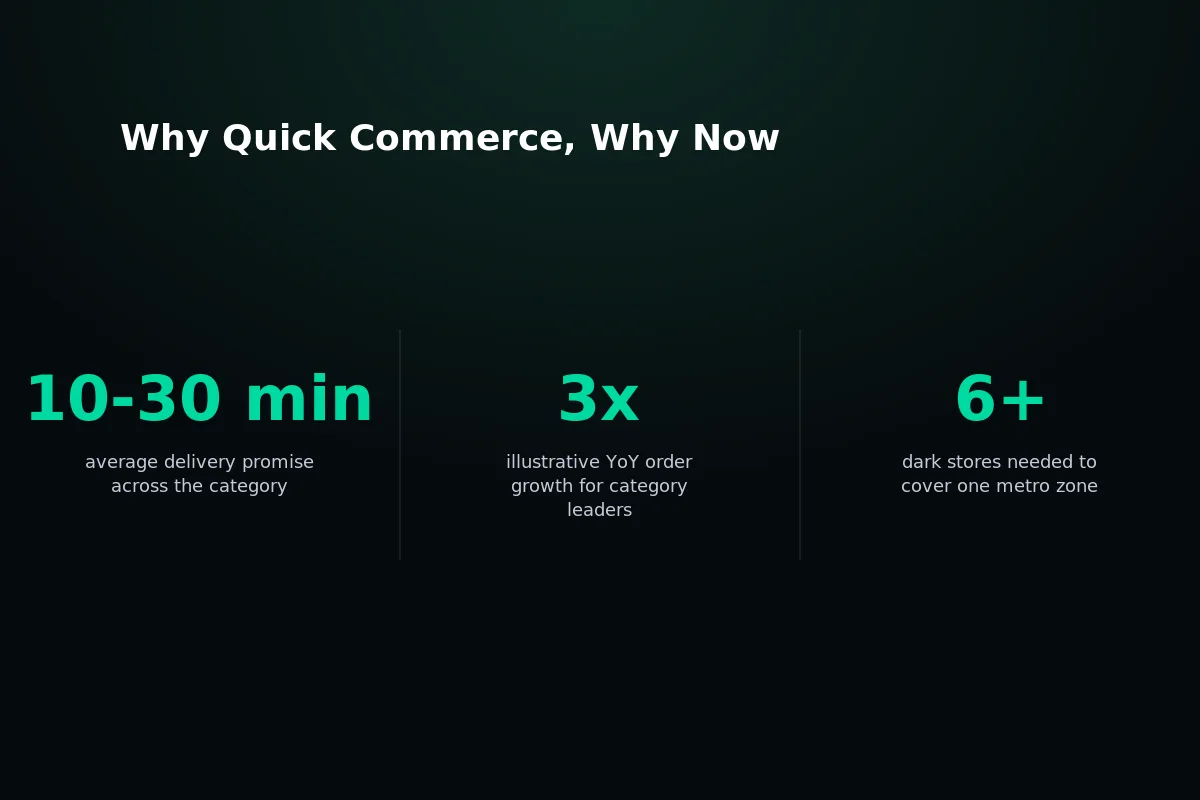 India’s quick commerce market has scaled from a metro-city experiment to a multi-billion-dollar category in under five years.
What a Quick Commerce App Actually Requires
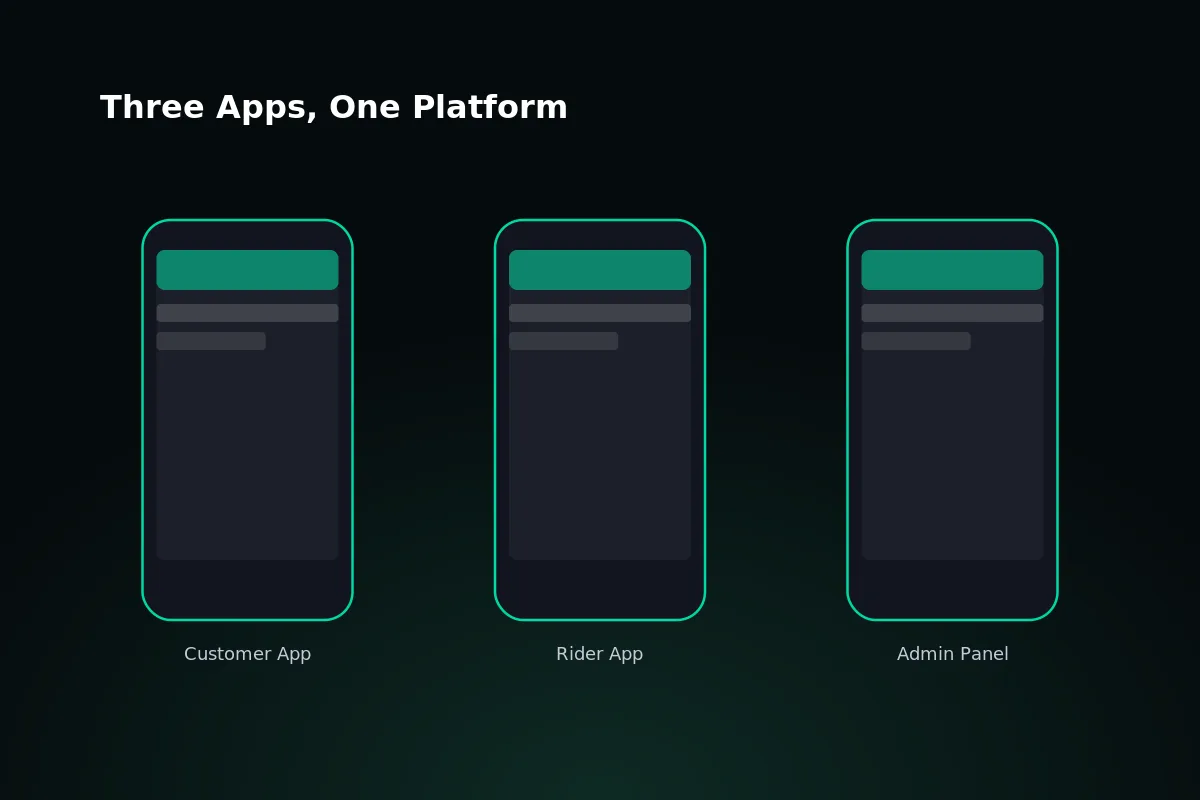
A quick commerce app is not one product — it is three connected systems that all have to operate in real time.
That means a customer app for browsing and ordering, a dark-store and rider app for the people picking, packing and delivering the order, and an admin panel that gives operations teams visibility across every dark store and delivery zone.
These three surfaces have to exchange information within seconds, not minutes, because the entire product promise — groceries in 10 to 30 minutes — depends on it.
This is what makes quick commerce a genuinely different engineering problem from regular e-commerce. A standard online store can tolerate eventual consistency: inventory syncs periodically, delivery windows are generous, and a warehouse many kilometres away is fine. None of that works here.
Serviceability has to be resolved instantly for the shopper’s exact location — is this address covered, and by which dark store? Inventory at that specific store has to be accurate to the unit, because there is no time cushion to substitute items later.
And dispatch — matching a live order to a rider who is already nearby — has to happen algorithmically and immediately, because every extra minute of delay eats directly into the delivery promise. Get any one of these three systems wrong and the 10-30 minute claim collapses.
 QuickKart is three connected products — customer app, QuickKart Rider app and admin panel — built to operate in real time.
Core Features You Need to Launch
A launch-ready quick commerce build needs to get six things right from day one. These are not nice-to-haves — miss any one of them and the app either fails to deliver on time or fails to comply with how India regulates e-commerce disclosures.
 Serviceability status, delivery slot selection and a transparent fee breakdown, shown directly inside the QuickKart customer app.
Dark-store serviceability and live ETA. Every order starts with a serviceability check — a geofence and pincode resolution engine that instantly returns whether an address is SERVICEABLE, UNSERVICED, or covered by a store that is currently CLOSED or PAUSED, along with the ETA. That ETA is not a static number; it comes from a live promise engine that combines the item’s prep time, the current order queue at that dark store, and the distance of the nearest available rider — all capped by a configurable ceiling so the app never promises a delivery time it cannot hit.
Delivery slot booking. Not every order needs to be instant. QuickKart supports both express delivery and scheduled delivery slots, each with its own capacity limit per dark store, so a customer can choose a 20-minute express drop or book a slot for later in the day without overloading riders at any one time.
A transparent, server-computed fee engine. Delivery fee, handling fee, surge fee, small-cart fee and COD fee are all calculated server-side — the app does zero client-side math. That matters for more than accuracy: India’s Consumer Protection (E-Commerce) Rules require platforms to disclose exactly how charges are broken down, and QuickKart shows that breakdown to the customer at checkout by design, not as an afterthought.
Rider dispatch and live tracking. The rider app takes an order through Accept → Picked up → Arriving → Delivered, with OTP capture at handover so every delivery is verifiable, one-tap hand-off into Google Maps for turn-by-turn navigation, and a running earnings and shift summary with a simple online/offline toggle so riders control their own availability.
Wallet, rewards and repeat-purchase tools. Wallet balance, reward points, coupon codes, a wishlist, and product reviews and Q&A are all built in — the retention layer that turns a first-time order into a habit, which is the entire economics of quick commerce.
India-specific compliance fields. Grocery and FMCG products carry Legal Metrology declarations (MRP, net quantity, manufacturer details) and FSSAI food-safety fields wherever applicable, built into the product catalog itself rather than bolted on later.
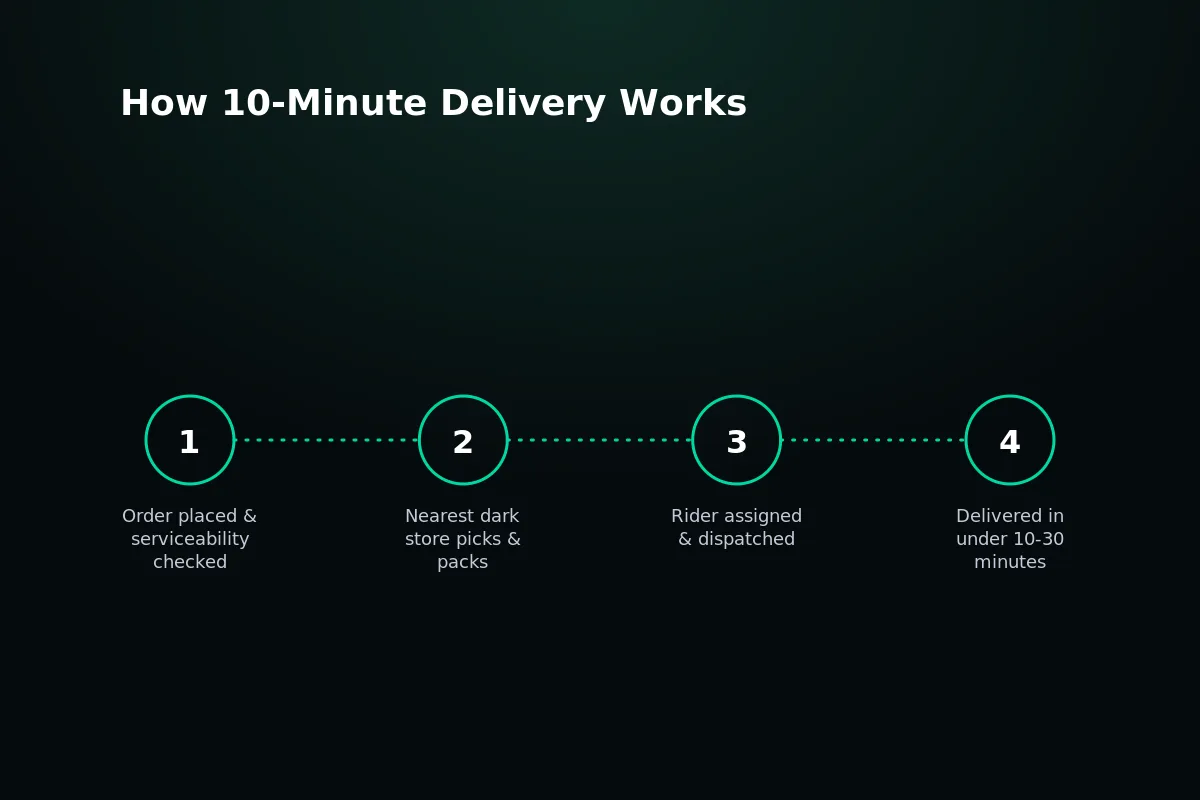 Every QuickKart Rider order moves through Accept, Picked up, Arriving and Delivered, with OTP capture at handover.
The Dark-Store Operating Model
A dark store is not a traditional retail outlet — it is a small, closed-to-walk-in warehouse stocked for fast picking, usually covering a radius of two to three kilometres so that every address inside its zone can realistically be reached within the delivery promise.
Layout is optimised the way a kitchen is optimised for a chef’s workflow: fast-moving SKUs near the packing station, cold-chain items in dedicated units, and picking routes designed to minimise the seconds a picker spends walking the floor.
The moment an order comes in, it is assigned to the nearest dark store with available inventory and picking capacity — not simply the nearest store on a map.
Operationally, every order moves through the same three stages: pick, pack, dispatch.
A picker works off a digital pick-list generated the instant the order is confirmed, packing happens at a dedicated station with quality and quantity checks, and dispatch hands the packed order to whichever rider is already closest and available — not the next rider in a queue.
Zone coverage is what ultimately determines whether the 10-30 minute promise is even mathematically possible: a dark-store network with poor zone density will always struggle to hit that number, no matter how good the app is.
For a deeper look at how this model works end to end, see our breakdown of how the dark-store model lets platforms deliver in 10 minutes.
 Operations teams monitor every dark store’s order queue, rider availability and delivery performance from a single admin panel.
Tech Stack That Actually Scales
QuickKart is built on Flutter for both the customer and rider apps, giving a single codebase that ships natively to iOS and Android without maintaining two separate mobile teams.
The backend runs on NestJS with Prisma as the ORM against PostgreSQL, with Redis handling the parts of the system that cannot afford a database round-trip — live rider locations, dispatch queues, and ETA calculations that need to update every few seconds across thousands of concurrent orders.
This combination matters specifically because of what quick commerce demands: PostgreSQL gives you transactional integrity for inventory and orders, Redis gives you the speed for real-time state, and NestJS’s structured, modular architecture makes it realistic to add new zones, new fee rules or new dark stores without destabilising the rest of the platform.
Feature flags are server-toggleable throughout, so operations can turn a feature on or off per city without shipping a new app build.
Why Launch on QuickKart Instead of Building From Scratch
Building the system described above — a live serviceability engine, a promise-based ETA calculator, a fee engine that satisfies Indian disclosure law, and a full rider-dispatch stack — from a blank repository typically takes a funded engineering team six to twelve months before the first real order ships.
QuickKart exists so that timeline is not the starting point. It is a complete, working quick commerce platform — customer app, QuickKart Rider app and admin panel — sold as ready-made, white-label source code that a founder owns outright.
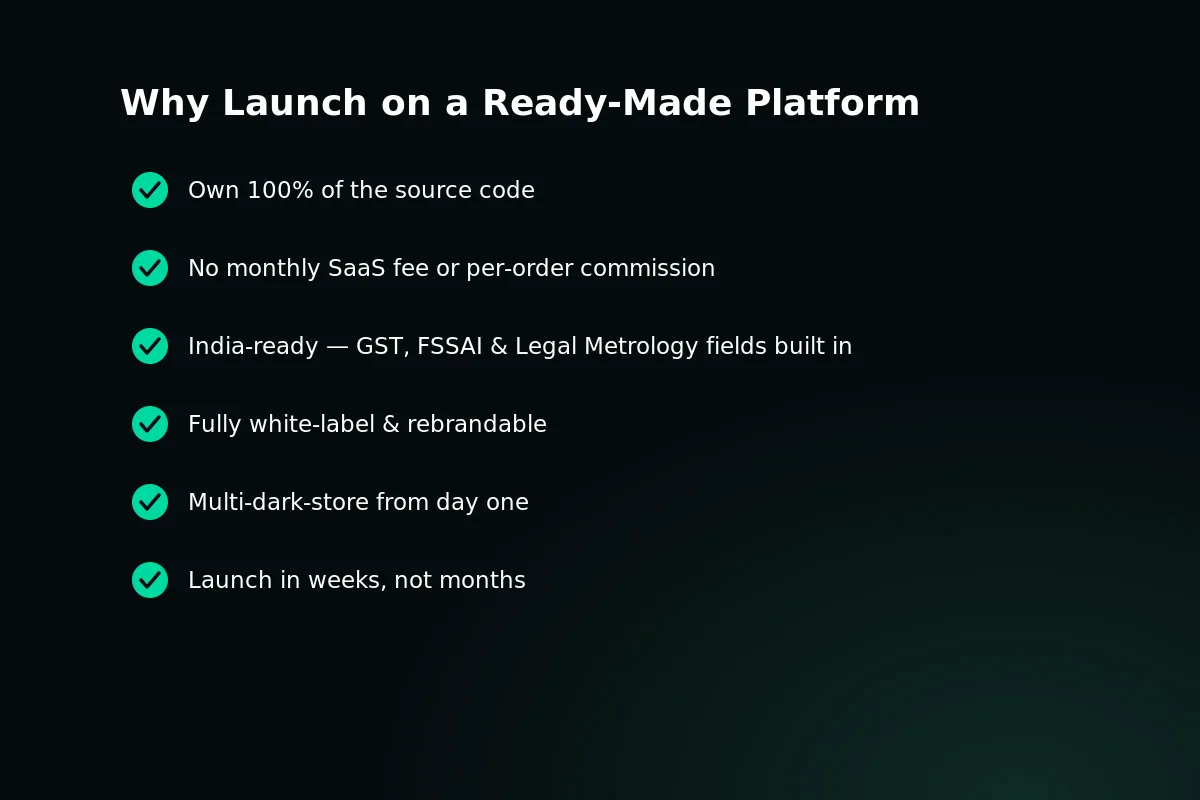 Faster launch, full source-code ownership and India-ready compliance fields — built in from day one.
Time-to-market in weeks, not months. The dark-store logic, fee engine, rider dispatch and compliance fields are already built and tested — your team configures zones, fees and catalog data instead of writing the platform from scratch. See our breakdown of what a Blinkit-style build actually costs in 2026 for the comparison.
You own the source code. This is not a SaaS subscription or a franchise model — the codebase is yours, hosted where you choose, modified however your business needs.
No per-order commission back to PRS. Once you launch, every rupee of delivery fee, handling fee and margin is yours; there is no ongoing revenue share on your orders.
India-ready compliance out of the box. Legal Metrology fields, FSSAI declarations and a disclosure-compliant fee breakdown are already part of the product catalog and checkout flow, not a later compliance project.
Fully white-label. Your brand, your app store listing, your domain — QuickKart is the engine underneath, not a co-branded product.
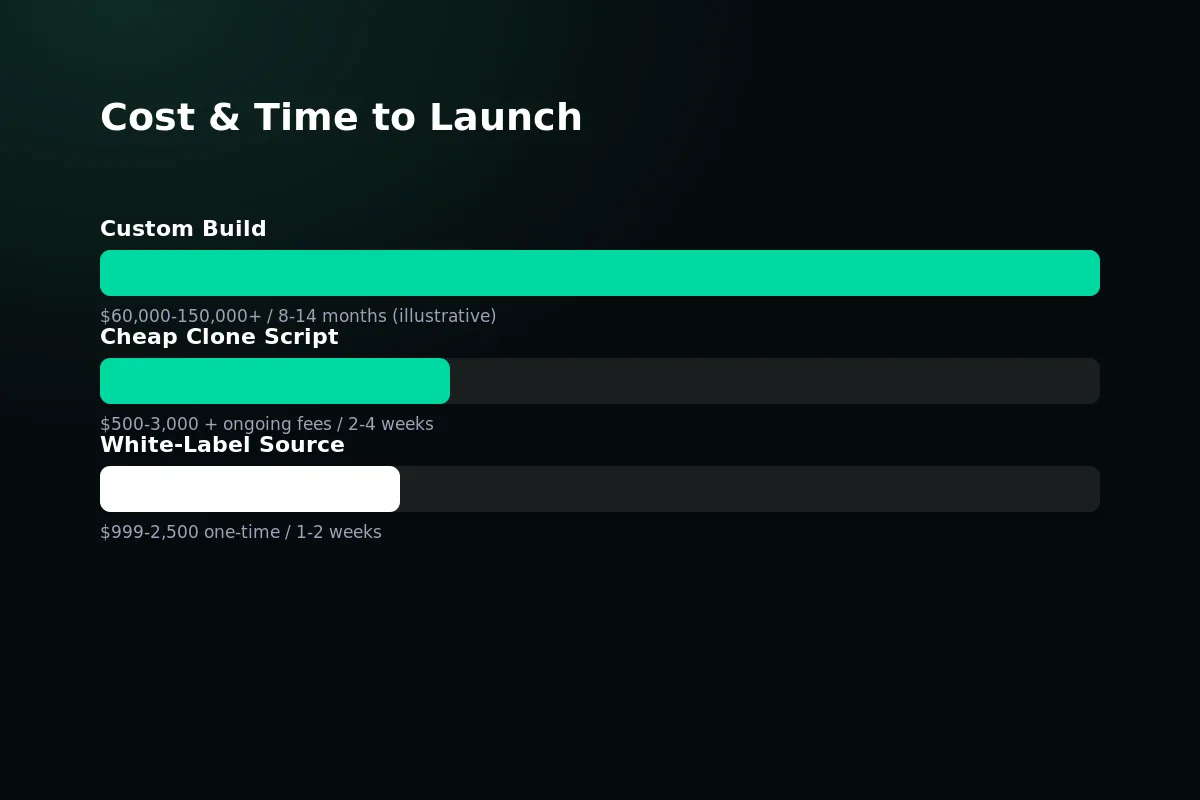 Licensing a ready-made platform typically costs a fraction of a from-scratch build — and ships months sooner.
If you are comparing the cost of licensing QuickKart against building in-house, talk to our team for a scoped estimate based on your city and category mix.
Frequently Asked Questions
What is the minimum viable feature set for a quick commerce app launch?
At minimum you need serviceability resolution (so the app knows instantly whether it can deliver to an address), a live inventory feed per dark store, a fee engine that discloses charges transparently, and a rider app covering accept-to-delivered with OTP handover.
Wallet, rewards, coupons and reviews matter for retention but can follow in a fast second release rather than blocking day one.
How is a quick commerce app different from a regular e-commerce delivery app?
Regular e-commerce can tolerate delay — a 3-5 day delivery window, periodic inventory sync, a distant warehouse. Quick commerce cannot.
Serviceability, live inventory and rider dispatch all have to resolve in real time against a single dark store within a two-to-three-kilometre zone, because the entire product promise is a 10-30 minute delivery window, not a date range.
Can QuickKart be customized for a specific city or region?
Yes. Dark-store zones, delivery fees, slot capacity, surge rules and even which product categories are sold are all configuration, not code changes — a founder launching in one city or a specific regional cluster sets zone boundaries and fee rules for that market without touching the underlying platform.
How long does it take to launch a quick commerce app with QuickKart?
Because the customer app, rider app, admin panel and backend are already built, most launches move from kickoff to a live app in a matter of weeks — the work left is branding, catalog upload, dark-store zone configuration and app store submission, not core engineering.
Written by
PRS Admin
Building software at PRS India.